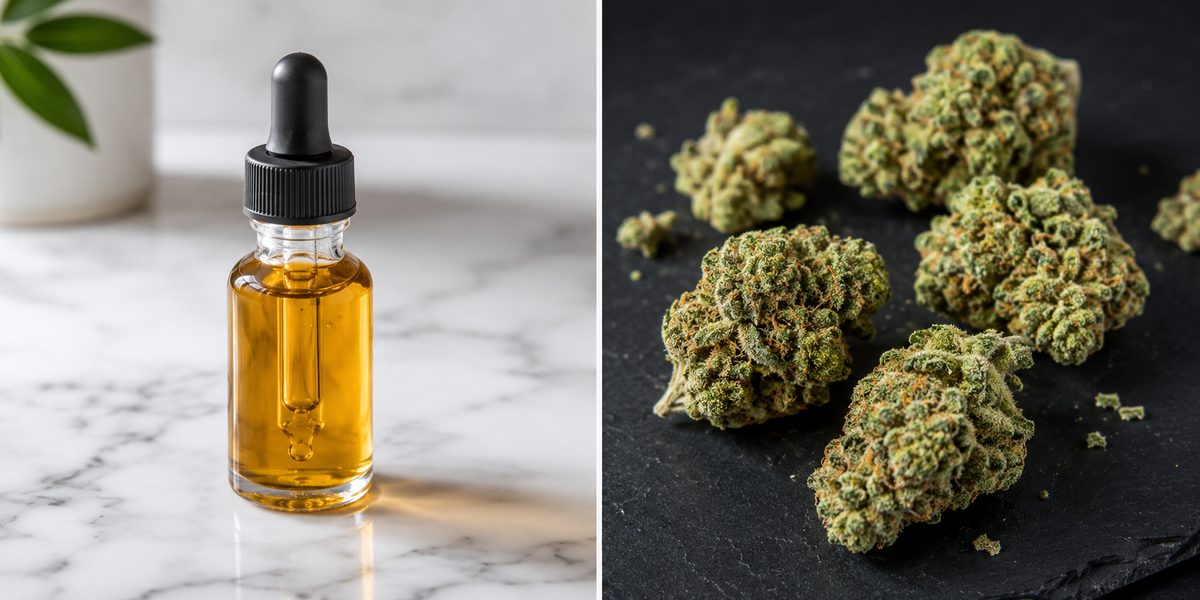
The Basics
CBD (cannabidiol) and THC (tetrahydrocannabinol) are both cannabinoids — chemical compounds found naturally in the cannabis plant. They share the exact same molecular formula (C₂₁H₃₀O₂) but differ in how their atoms are arranged. That small structural difference produces dramatically different effects.
THC is the cannabinoid that gets you high. It binds directly to CB1 receptors in your brain, producing euphoria, altered perception, and the classic cannabis "buzz."
CBD does not get you high. It interacts with the endocannabinoid system more indirectly, influencing receptors involved in pain, mood, inflammation, and sleep — without producing intoxication.
Key takeaway: Same plant, same molecular formula, completely different experiences. CBD is the wellness side. THC is the psychoactive side. Many products combine both for what's called the "entourage effect."
Side-by-Side Comparison
| CBD | THC | |
|---|---|---|
| Gets you high? | No | Yes |
| Psychoactive? | Non-intoxicating (may affect mood) | Intoxicating |
| Federally legal? | Yes (if <0.3% THC, hemp-derived) | No (except hemp-derived delta-9 <0.3%) |
| Drug test risk? | Low (full-spectrum may cause a positive) | High — most tests screen for THC metabolites |
| Common uses | Anxiety, pain, inflammation, sleep, seizures | Pain, nausea, appetite, recreation, sleep |
| Side effects | Mild: drowsiness, dry mouth, diarrhea | Anxiety, paranoia, impaired memory, dry mouth |
| FDA-approved forms? | Yes — Epidiolex (for epilepsy) | Yes — Marinol, Syndros (synthetic THC) |
| Source | Typically from hemp | Typically from marijuana (or hemp-derived) |
Effects on the Body
Both CBD and THC work through the body's endocannabinoid system (ECS), a network of receptors found throughout the brain, nervous system, and immune system. But they interact with this system in very different ways.
How THC Works
THC binds directly to CB1 receptors, which are concentrated in the brain. This direct binding is what produces the "high" — euphoria, altered time perception, increased appetite, and sometimes anxiety or paranoia at higher doses. THC also has legitimate medical applications: it's FDA-approved in synthetic forms for chemotherapy-induced nausea and AIDS-related appetite loss.
How CBD Works
CBD doesn't bind strongly to CB1 or CB2 receptors. Instead, it modulates the ECS indirectly — it may slow the breakdown of your body's own endocannabinoids, and it interacts with serotonin receptors (which is likely why people report anti-anxiety effects). CBD has one FDA-approved medication: Epidiolex, which is prescribed for certain severe forms of epilepsy.
The Entourage Effect: Many researchers believe CBD and THC work better together than alone. Full-spectrum products contain both cannabinoids (plus others like CBN, CBG, and terpenes), which may produce stronger effects than isolated compounds. This is why full-spectrum CBD oils are often preferred over CBD isolate.
Legality
This is where things get complicated. The short version:
CBD is federally legal when derived from hemp (defined as cannabis with less than 0.3% THC by dry weight), thanks to the 2018 Farm Bill. However, individual states can and do add restrictions — some require CBD products to be THC-free, others restrict certain product types like edibles or vapes.
THC is federally illegal as a Schedule I substance, with two important exceptions: (1) hemp-derived delta-9 THC products that contain less than 0.3% THC by dry weight are technically legal under the Farm Bill, and (2) marijuana is legal for medical and/or recreational use in a growing number of states.
Delta-8 THC exists in a legal gray area. It's derived from hemp CBD through a conversion process, so some argue it's protected by the Farm Bill. However, more than 20 states have explicitly banned or restricted delta-8.
Check Your State's Laws
CBD, delta-8, and THC legality varies widely. Use our interactive map to see what's legal where you live.
Open the Legality Map →Drug Testing
This is one of the most-asked questions in cannabinoids, and the answer is important: most standard drug tests screen for THC metabolites, not CBD.
Pure CBD isolate should not trigger a positive drug test, because it contains zero THC.
Broad-spectrum CBD has had THC removed but may contain trace amounts. Risk is very low but not zero.
Full-spectrum CBD contains up to 0.3% THC. At high daily doses (over ~1,000mg), this can accumulate enough THC metabolites to trigger a positive result. If you're subject to drug testing, full-spectrum products carry a real risk.
Any THC product (delta-8, delta-9, THCA) will almost certainly trigger a positive result. Most tests cannot distinguish between delta-8 and delta-9 THC metabolites.
Bottom line: If drug testing matters for your job or legal situation, stick with CBD isolate or verified broad-spectrum products from brands that publish full panel lab reports. Don't risk it with full-spectrum or any THC product.
Full-Spectrum vs Broad-Spectrum vs Isolate
You'll see these terms on every CBD product label. Here's what they actually mean:
Full-Spectrum
Contains CBD + THC (up to 0.3%) + other cannabinoids + terpenes. Maximum entourage effect. Small drug test risk.
Broad-Spectrum
Contains CBD + other cannabinoids + terpenes, but THC has been removed. Good middle ground for drug test concerns.
CBD Isolate
Pure CBD only — 99%+ purity. No other cannabinoids, no terpenes, no THC. Safest for drug testing.
Live Resin / Full Extract
Extracted from fresh (not dried) cannabis. Preserves more terpenes and minor cannabinoids. Premium product tier.
Beyond CBD & THC
The cannabis plant produces over 100 cannabinoids. CBD and THC are the most abundant and well-studied, but others are gaining attention for their unique properties:
Delta-8 THC
A milder version of delta-9 THC. Produces a lighter, clearer high. Legal gray area. Converted from CBD in a lab.
THCA
The raw, non-psychoactive precursor to THC. Converts to THC when heated. Found in raw cannabis flower.
CBN
Cannabinol — a breakdown product of THC. Mildly sedating. Often marketed for sleep.
CBG
Cannabigerol — the "mother cannabinoid" that other cannabinoids are synthesized from. Early research suggests anti-inflammatory properties.
THCP
A potent variant of THC discovered in 2019. Binds to CB1 receptors more strongly than delta-9. Very potent.
HHC
Hexahydrocannabinol — a hydrogenated form of THC. Effects similar to delta-9 but milder. Longer shelf life.
We have deep-dive guides on each of these cannabinoids in our education hub.
Product Types
Both CBD and THC come in a wide range of product formats. The right format depends on what you're using it for, how fast you want it to work, and your personal preference.
Oils & Tinctures
Taken sublingually (under the tongue). Onset: 15–30 minutes. Duration: 4–6 hours. The most precise way to dose. Available in both CBD and THC formulations.
Best CBD & THC Oils — Our Top Picks
Lab-tested tinctures ranked by potency, price-per-mg, and third-party verification.
See our oil reviews →Gummies & Edibles
Easiest way to dose consistently. Onset: 30–90 minutes (must pass through digestive system). Duration: 6–8 hours. Pre-dosed so you know exactly how many mg per serving. The most popular product category.
Best CBD & THC Gummies for 2026
Taste-tested and lab-verified. Ranked by value, potency, and real user experience.
See our gummy reviews →Topicals
Creams, balms, and lotions applied directly to the skin. Don't enter the bloodstream significantly, so they target localized pain and inflammation. No psychoactive effects even with THC topicals. Onset: 15–45 minutes at the application site.
Vapes & Cartridges
Fastest onset of any format — effects within 1–5 minutes. Duration: 1–3 hours. Available as pre-filled cartridges, disposable pens, and refillable devices. Carries respiratory risks that other formats don't.
Flower
Raw cannabis buds, smoked or vaporized. Available as CBD hemp flower (legal) or THC marijuana flower (state-legal markets). Fastest onset alongside vapes. Contains the full spectrum of cannabinoids and terpenes naturally.
Capsules & Softgels
Pre-dosed like gummies, but without sugar or flavor. Ideal for people who want CBD or THC as part of a supplement routine. Same onset and duration as edibles (30–90 min onset, 6–8 hours).
Which Is Right for You?
The answer depends on what you're looking for:
Choose CBD if you want potential relief from anxiety, inflammation, or sleep issues without any intoxication. CBD is the safer bet if you're new to cannabinoids, subject to drug testing, or in a state where THC products aren't legal.
Choose THC if you want psychoactive effects — whether recreational or for conditions where THC has shown stronger evidence (like nausea, appetite stimulation, or certain pain conditions). Make sure you're in a state where it's legal, and start with a low dose.
Choose both if you want the entourage effect. Full-spectrum CBD products give you a small amount of THC alongside CBD and other cannabinoids. For stronger effects, look for balanced CBD:THC ratios in states where THC is legal.
Not Sure Where to Start?
Take our 5-question quiz and we'll recommend the right cannabinoid and product type for your goals.
Take the Quiz →Medical Disclaimer: This article is for educational purposes only and is not medical advice. Consult a healthcare provider before starting any cannabinoid supplement, especially if you take prescription medications. The FDA has not evaluated the statements on this page. Products mentioned are not intended to diagnose, treat, cure, or prevent any disease.